
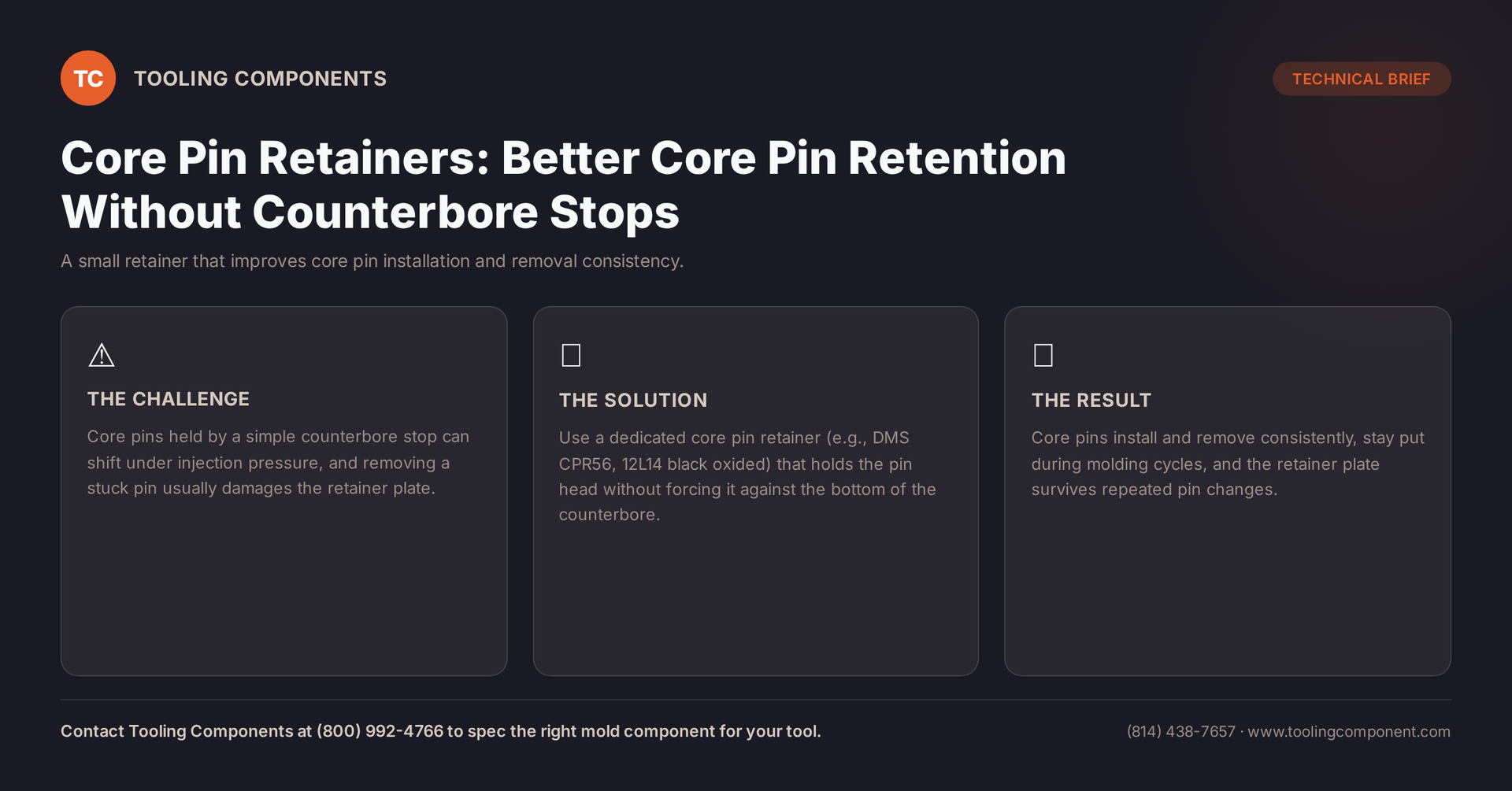
Los pasadores de núcleo se encuentran entre los componentes más cargados en un molde de inyección. Forman características profundas, orificios y geometría lateral, y absorben presión de inyección en cada disparo. La forma en que se retiene el pasador en la placa de retención determina si el pasador permanece en servicio y si el fabricante de herramientas realmente puede sacarlo para repararlo o reemplazarlo.
El problema con un tope de avellanado simple
El método de retención más simple es un avellanado que asienta la cabeza del pasador. Funciona, pero tiene dos inconvenientes que se manifiestan en el taller de moldes. En primer lugar, las tolerancias se acumulan: si la profundidad del escariado o el grosor de la cabeza del pasador están fuera de lugar, la cabeza del pasador puede ser forzada contra la parte inferior del escariado, lo que crea una carga desigual y puede sacar el pasador de su escuadra. En segundo lugar, cuando un pasador se atasca (lo que sucede con pasadores de núcleo quemados, irritados o envueltos por llamas), el fabricante de herramientas tiene que hacer palanca contra el hombro avellanado, y eso daña repetidamente la placa de retención.
Qué hace un retenedor de pasador de núcleo de manera diferente
Un retenedor de pasador central dedicado (designación del catálogo DMS CPR, por ejemplo CPR56) soluciona ambos problemas. Captura la cabeza del pasador para que el retenedor no fuerce la cabeza contra la parte inferior del avellanador, lo que le da al pasador un asiento consistente disparo tras disparo. Debido a que el pasador se sujeta en lugar de pellizcar, la instalación y extracción son más consistentes, lo cual es importante cuando se intercambian pasadores entre ejecuciones o durante el mantenimiento del molde.
El retenedor también permite al fabricante de herramientas quitar y reinstalar el pasador sin hacer palanca contra la placa, por lo que la placa del retenedor sobrevive a los repetidos cambios del pasador. Para moldes con alta cavitación o herramientas que experimentan frecuentes cambios de pasador central, esa durabilidad reduce directamente el costo de mantenimiento del molde.
Materiales y tamaño
Los retenedores de pasador de núcleo estándar se fabrican comúnmente de acero 12L14 con acabado de óxido negro, un grado de mecanizado libre que mantiene las tolerancias que necesita la cabeza del pasador y al mismo tiempo resiste la corrosión durante el almacenamiento. El tamaño depende del diámetro de la cabeza (o del cuerpo) del pasador y del espesor de la placa al que debe ajustarse el retenedor; Los números de pieza de DMS especifican el diámetro, la longitud y la variante deseados para producir el número de catálogo. Si las medidas están fuera de las combinaciones originales, el fabricante no las producirá: un buen recordatorio para medir la cabeza del pasador y el avellanado antes de realizar el pedido.
Cuándo recurrir a un retenedor
- Pasadores centrales profundos o largos que experimentan una alta presión de inyección y necesitan retención positiva.
- Herramientas que pasan por cambios frecuentes de pasador de núcleo, donde el desgaste de la placa por la palanca es un costo real.
- Pasadores de núcleo frágiles o de paredes delgadas donde el asiento cuadrado es fundamental para evitar que se doblen.
- Moldes donde las tolerancias de profundidad del escariado son difíciles de mantener de manera consistente.
Si está reemplazando una retención estilo avellanado desgastada o diseñando una nueva herramienta, envíenos el diámetro de la cabeza del pasador central, el grosor de la placa de retención y la longitud del pasador. Combinaremos un retenedor original para que sus pasadores se asienten de manera consistente.
Enchufe de artículo del catálogo: Tooling Components vende retenedores de pasador central (serie CPR) de PCS, DMS y Progressive Components en acero oxidado negro 12L14, dimensionados por diámetro, longitud y variante para una retención consistente del pasador central.