
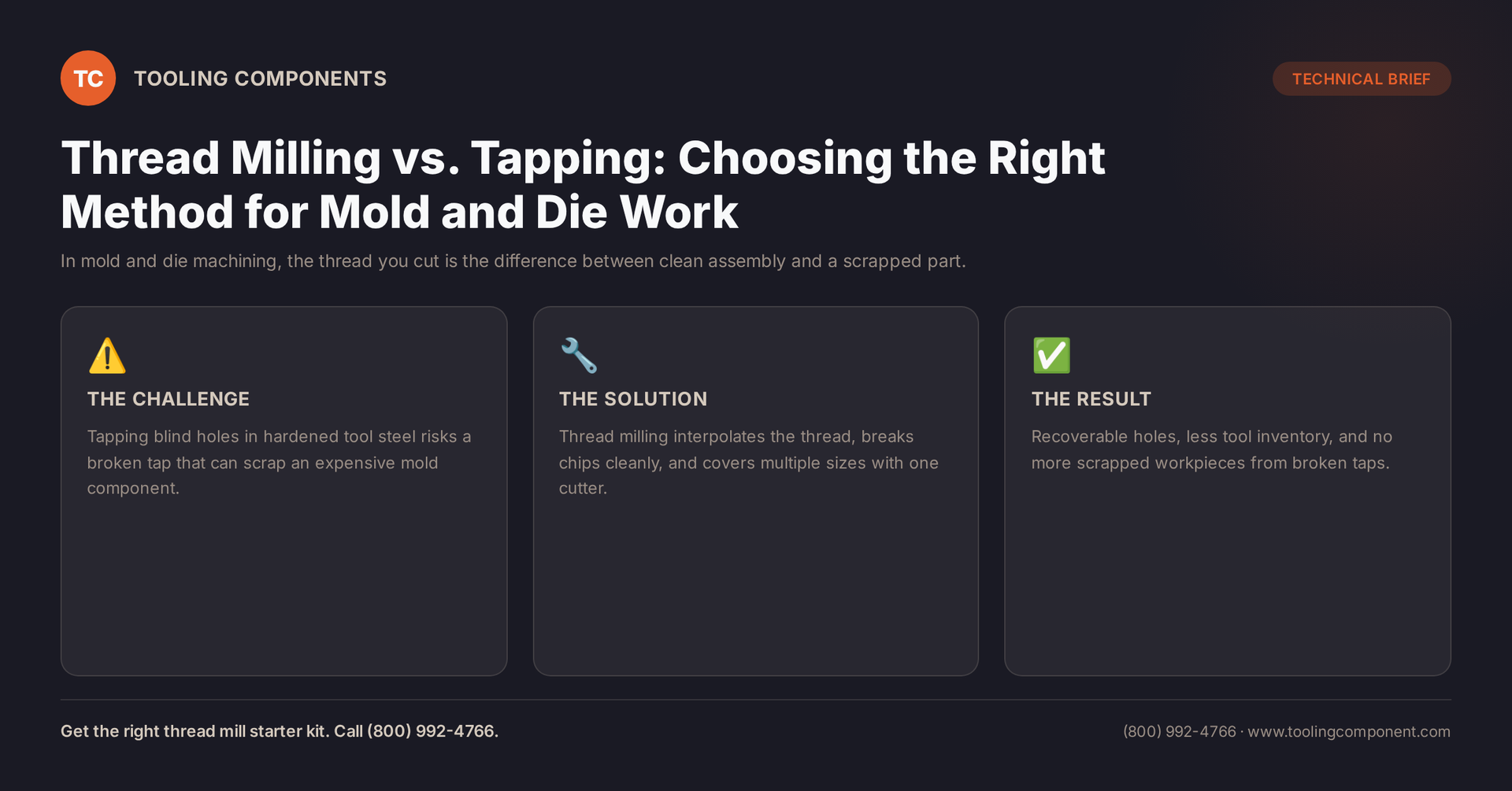
Fresado de roscas versus roscado: elegir el método correcto para el trabajo de moldes y matrices
En el mecanizado de moldes y troqueles, la rosca que se corta suele ser la diferencia entre una pieza que se ensambla limpiamente y una pieza que se desecha después del tratamiento térmico. Los dos métodos dominantes (cortar roscas con un macho o interpolarlas con una fresadora de roscas) tienen ventajas muy diferentes y elegir mal cuesta tiempo, herramientas o ambos.
Cómo funciona cada método
El roscado utiliza un macho que corta la forma completa de la rosca en una sola pasada a medida que gira y avanza. Es rápido, sencillo y no requiere programación especial. El problema: un macho es una herramienta de tamaño fijo, por lo que necesita un macho por tamaño de rosca, y un macho roto en un orificio ciego en acero para herramientas endurecido es una pesadilla que puede raspar la pieza de trabajo.
El fresado de roscas utiliza una sola fresa que interpola una trayectoria helicoidal para generar la rosca. Una fresadora de roscas puede producir una variedad de tamaños de rosca (simplemente cambie la trayectoria de la herramienta) y corta con contacto interrumpido que rompe las virutas limpiamente, lo cual es importante en materiales gomosos o endurecidos.
Cuando gana el roscado
- A través de orificios en aluminio, acero dulce, y otros materiales de mecanizado libre.
- Tamaños de rosca pequeños donde el diámetro mínimo del cortador de una fresa de roscar se vuelve frágil.
- Producción de gran volumen donde el tiempo del ciclo de roscado es difícil de superar.
- Cuando su taller aún no ha invertido en capacidad de interpolación helicoidal.
Cuando gana el fresado de roscas
- Agujeros ciegos en acero para herramientas endurecido. Si se rompe un macho, la pieza suele estar tostada. Una fresa de roscar rompe las virutas y las evacua, y si se rompe, la fresa es barata y el orificio se puede recuperar.
- Múltiples tamaños de rosca con una sola herramienta. Una fresa de roscar cubre un rango, lo que reduce el inventario de herramientas y los cambios de configuración.
- Diámetros grandes. Cuanto más grande es la rosca, más supera el requisito de torque del roscador.
- Pasos no estándar y roscas a izquierdas. Sin especiales se necesita orden de macho: solo prográmelo.
El marco de decisión práctico
Hágase cuatro preguntas. ¿El agujero es ciego o pasante? ¿El material está endurecido o gomoso? ¿El tamaño de la rosca es grande (más de aproximadamente 3/8 de pulgada) o pequeño? ¿Y qué tan doloroso sería una herramienta rota para esta pieza de trabajo? Si la respuesta a "qué doloroso" es "mucho", el fresado de roscas es su respuesta. Las bases de molde, los pasadores centrales y las roscas de la carcasa del eyector en P-20 y H-13 preendurecidos son aplicaciones de fresado de roscas de manual.
Cuando machaca, y muchas aplicaciones todavía lo requieren, haga coincidir el macho con el orificio. Los machos de punta en espiral (pistola) empujan las virutas hacia adelante para pasar los orificios; Los machos de flauta en espiral extraen las virutas de los agujeros ciegos. Usar el estilo de macho incorrecto en la geometría de orificio incorrecta es la principal causa de machos rotos, punto.
Artículo de catálogo relacionado: Tooling Components cuenta con machos de roscar HSS y cobalto, machos de roscar con punta en espiral, machos de roscar con flauta en espiral, fresas de roscar y juegos combinados completos de taladro/macho para talleres de moldes y troqueles. Pregunte por nuestro kit inicial de fresadora de roscas del tamaño adecuado para las indicaciones de roscas comunes de base de molde.
¿No estás seguro de qué método se adapta a tu próximo trabajo? Llame al 814-438-7657 o visite www.toolingcomponent.com: nuestro equipo técnico trabaja con talleres de moldes y troqueles todos los días.