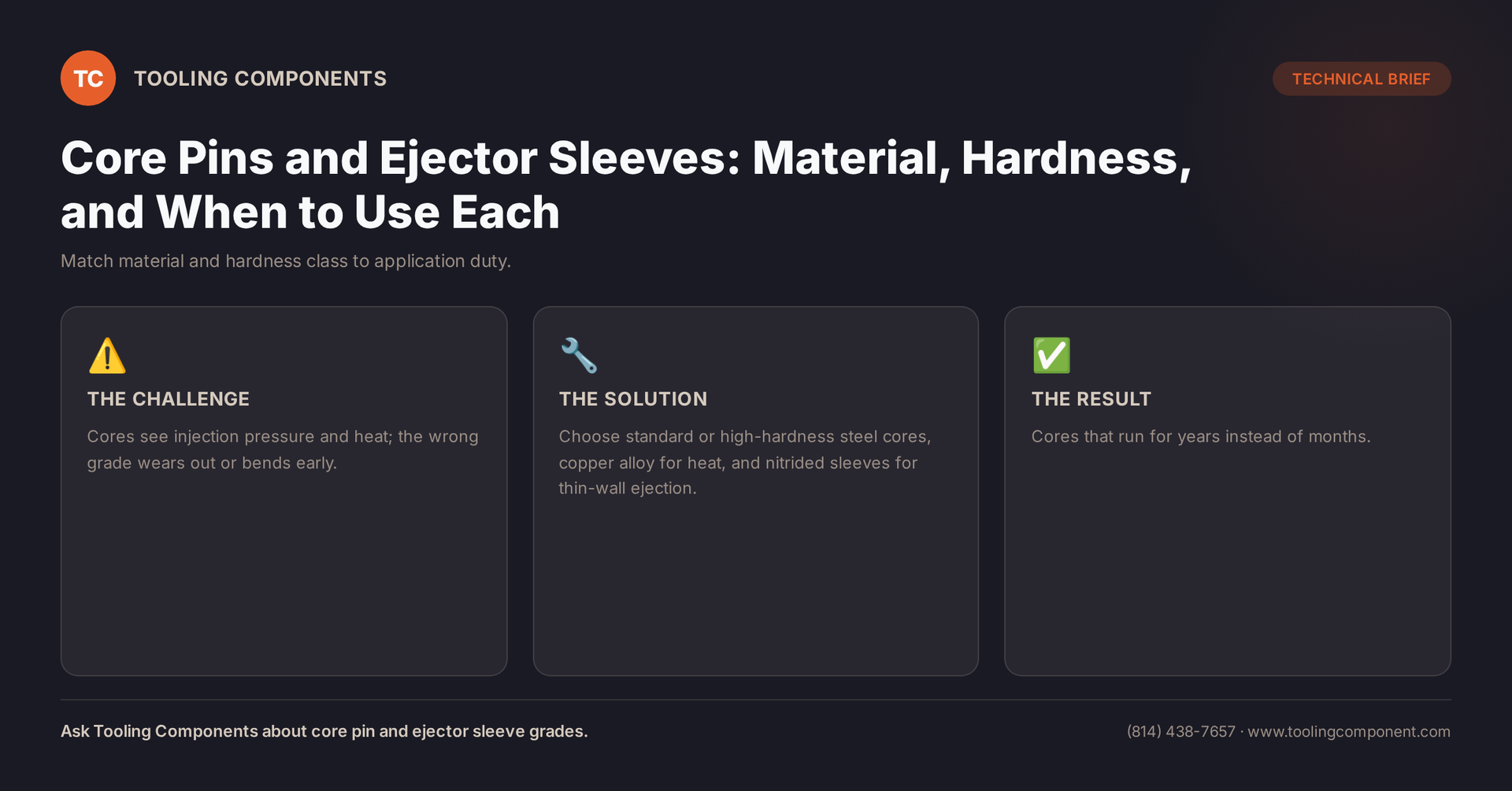
Core pins form the internal geometry of a molded part; ejector sleeves push thin-wall parts off those cores. Both are precision wear components, and their material and hardness classes map directly to application duty. This guide walks through the classes Tooling Components stocks.
Core Pins: Standard vs. High Hardness
Core pins come in two hardness classes. Standard hardness (soft) core pins are the general-purpose choice — tough and machinable for modifications, ideal for cores that see moderate wear. High hardness (hard) core pins carry a higher surface hardness for abrasive resins, glass-filled materials, and cores with thin steel sections that need maximum wear resistance. The ordering principle is the same as ejector pins: match hardness to the wear environment, and don't over-specify hardness where toughness is what keeps the pin alive.
Copper Alloy Core Pins: When the Core Needs to Move Heat
For cores that are too thin or too deep for a conventional waterline, copper alloy core pins are the answer. Copper alloys conduct heat far better than tool steel, so the pin itself becomes a heat-transfer element — pulling heat out of the plastic and moving it to a cooling circuit, an ejector housing, or a heat sink. Copper alloy cores trade some surface hardness for thermal performance, so they are typically specified for thermal management rather than wear duty. If the application has both requirements, the mold builder may pair a copper alloy core with a steel sleeve or a hard coating.
Ejector Sleeves: Thin-Wall Ejection Without Part Damage
An ejector sleeve surrounds a core pin and pushes the part off with a full annular face — the right tool for thin-wall parts, ribs, and bosses where a round ejector pin would punch through or distort the part. Nitrided parallel sleeves use the same H13/nitriding process as the pin line, giving a hard-wearing surface with a tough core. Oversize sleeves are available for repair work, and through-hardened sleeves cover heavier ejection duty.
Putting It Together
For a typical thin-wall cup or housing: use a high-hardness steel core pin for wear, a nitrided ejector sleeve for clean ejection, and a copper alloy core pin only where the thermal calculation shows steel cannot move enough heat. When gating or ejection geometry forces a small-diameter core, step up hardness class before stepping up pin diameter — it preserves the part geometry without weakening the mold.
Tooling Components carries core pins (standard, high-hardness, and copper alloy), ejector sleeves, and retainers in inch and metric sizes. Call 814-438-7657 or visit www.toolingcomponent.com.