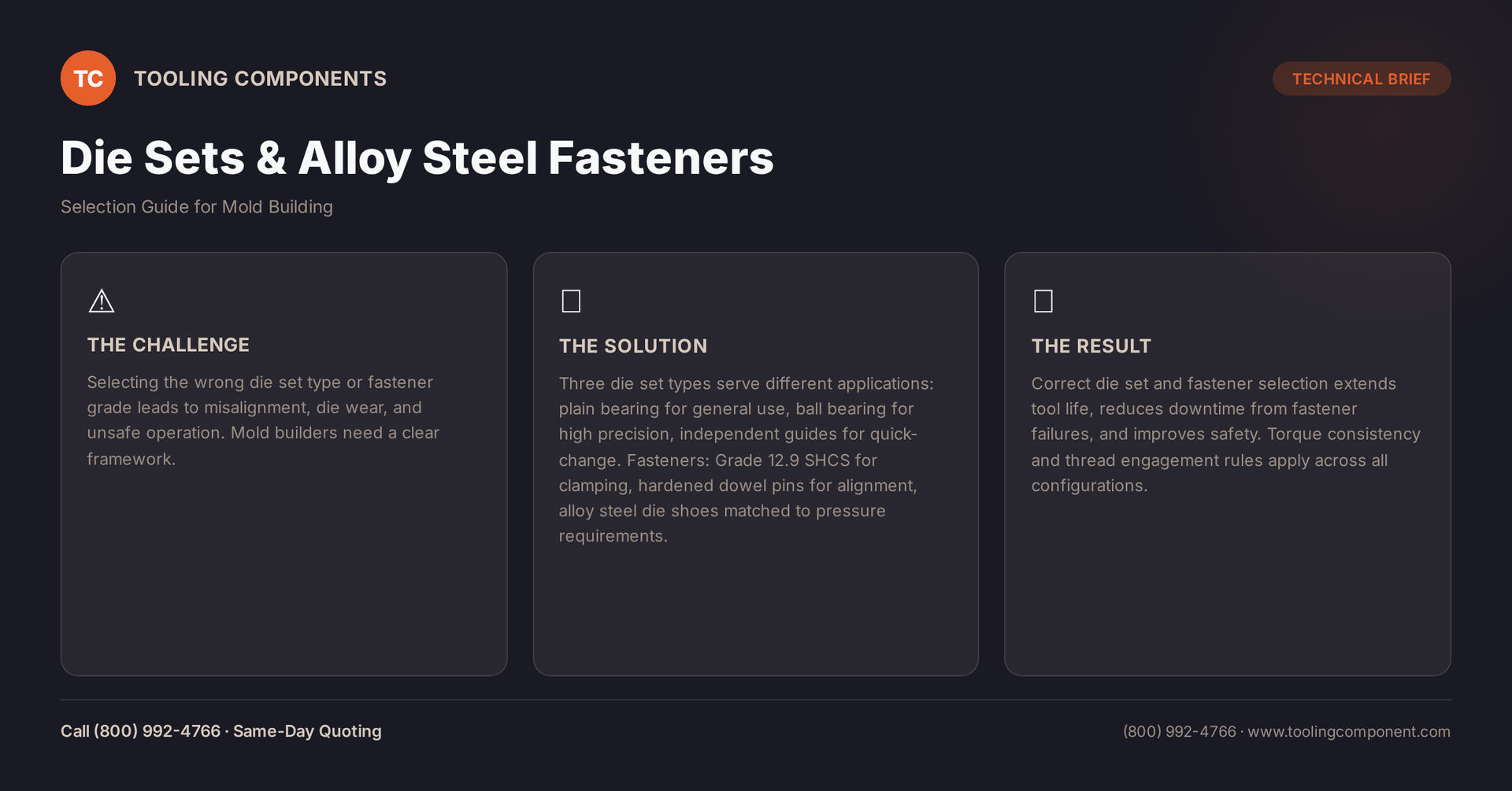
Die Sets and Alloy Steel Fasteners: The Foundation of Precision Mold Building
Every injection mold or stamping die begins with a die set — the assembly of guide pins, bushings, and die shoes that establish alignment and support the working components. And every die set relies on alloy steel fasteners to hold those components in place. Selecting the wrong configuration or fastener grade introduces misalignment, premature wear, and safety risk.
This guide covers the types of die sets, the alloy steel fastener grades used in mold construction, and how to match both to your application.
Die Set Types for Mold Building
Die sets fall into three primary configurations, distinguished by how the guide pins interact with the bushings:
| Type | Construction | Best Application | Clearance |
|---|---|---|---|
| Plain Bearing Die Set | Solid guide pin running in a bronze-plated or steel bushing with grease grooves | General purpose injection molds, moderate-speed stamping dies, prototype tooling | 0.0005"–0.0015" per side |
| Ball Bearing Die Set | Recirculating ball bushings around the guide pin — minimal friction, no metal-to-metal contact | High-production molds, multi-cavity tooling, precision dies requiring long stroke and zero galling | 0.0001"–0.0003" per side |
| Independent Guide Pin Set | Spring-loaded guide pins mounted separately from the die shoes; pins retract into the shoe when opened | Quick-change dies, transfer tooling, applications where the die set must separate completely | Varies by design |
Key selection rule: Use plain bearing for general-purpose tooling under 200 strokes per minute. Switch to ball bearing for high-cycle, tight-tolerance applications where pin galling or bushing wear causes downtime.
Alloy Steel Fasteners in Mold Construction
Fasteners in a die set aren't generic hardware — they are precision-ground, heat-treated alloy steel components selected for their tensile strength, shear resistance, and fatigue life.
Socket Head Cap Screws (SHCS) — Grade 12.9
The primary fastener for clamping die sections, retainers, stripper plates, and cavity inserts. Grade 12.9 is the highest standard grade for hex-socket cap screws:
- Material: 4137 or 4140 alloy steel, quenched and tempered
- Minimum tensile strength: 180,000 psi (1,240 MPa)
- Hardness: 39–44 HRC
- Features: Black oxide or phosphate-coated for corrosion resistance; precision threads (class 3A fit for consistent preload)
Dowel Pins — Hardened Alloy Steel
Dowel pins provide precise, repeatable alignment between the die shoe halves, cavity inserts, and removable components. Unlike SHCS, dowel pins are purely alignment devices — they take shear load but no tension:
- Material: 52100 bearing steel or 4140, through-hardened to 58–62 HRC
- Ground finish: 0.0001"–0.0002" oversize for interference fit in the fixed component, slip fit in the mating component
- Standard tolerance: ISO m6 or h6 fit class
Die Springs and Shoulder Bolts (Stripper Bolts)
Shoulder bolts (also called stripper bolts) combine a precision ground shoulder with a threaded end — they guide the stripper plate while allowing vertical travel. Made from alloy steel (4140, 41xx series), heat-treated to 37–42 HRC.
Material Specifications for Die Shoes
| Material | Hardness | Tensile Strength | Best For |
|---|---|---|---|
| 4140 Pre-Hardened | 28–32 HRC | 140–160 ksi | General-purpose die shoes — good machinability-strength balance, most common choice |
| 4340 | 30–36 HRC | 150–180 ksi | Large dies, high-cavity-pressure molds — higher toughness than 4140 |
| 4130 Normalized | 20–25 HRC | 90–110 ksi | Complex die builds requiring welding — best weldability of the 41xx series |
| Tool Steel (A2, D2, S7) | 58–62 HRC | 250+ ksi | Master die sets, high-wear applications — carburized for wear resistance, expensive |
Fastener Installation Best Practices
- Thread engagement: Minimum 1.5× the screw diameter in steel (e.g., a 3/8" SHCS needs at least 0.56" of thread engagement)
- Torque consistency: Use lubricated threads (light oil) and a calibrated torque wrench — unlubricated 12.9 fasteners can reach 70% of yield before the torque spec is met
- Torque sequence: Tighten in a cross pattern in three passes: 50% → 75% → 100%
- Thread locker: Medium-strength (blue) Loctite 242 for general use; high-strength (red) 271 for permanent clamping under vibration
- Inspection: Check SHCS for necking or thread distortion at every mold teardown — replace if there's any visible deformation
Common Fastener Failure Modes
| Failure Mode | Root Cause | Prevention |
|---|---|---|
| Head stripping | Overtorque or misaligned driver | Calibrate torque wrench; use ball-end hex drivers at full depth |
| Thread galling | Dry installation on 12.9 fasteners | Always lubricate threads with light machine oil or anti-seize |
| Fatigue fracture at thread root | Insufficient engagement or cyclic overloading | Maintain 1.5× diameter engagement; inspect at scheduled teardowns |
| Corrosion binding | Moisture in cooling circuit proximity | Use black oxide or zinc-nickel plated fasteners near cooling lines |
Checklist: Die Set and Fastener Selection
- [ ] Die set type matches cycle speed and precision requirements (plain vs. ball bearing)
- [ ] Die shoe material selected for operating pressure and welding requirements (4140 vs. 4340 vs. tool steel)
- [ ] All clamping fasteners are Grade 12.9 alloy steel or higher
- [ ] Dowel pins are hardened alloy steel with proper interference/slip fit per component function
- [ ] Thread engagement verified at 1.5× diameter minimum
- [ ] Torque specs documented and calibrated wrench available
- [ ] Thread lubricant applied to all 12.9 fasteners
- [ ] Inspection interval established for fastener condition at mold teardown
Need same-day pricing on die set components or alloy steel fasteners? Call Tooling Components at 814-438-7657 or email sales@toolingcomponent.com — engineered support for mold makers and die builders since 1987.