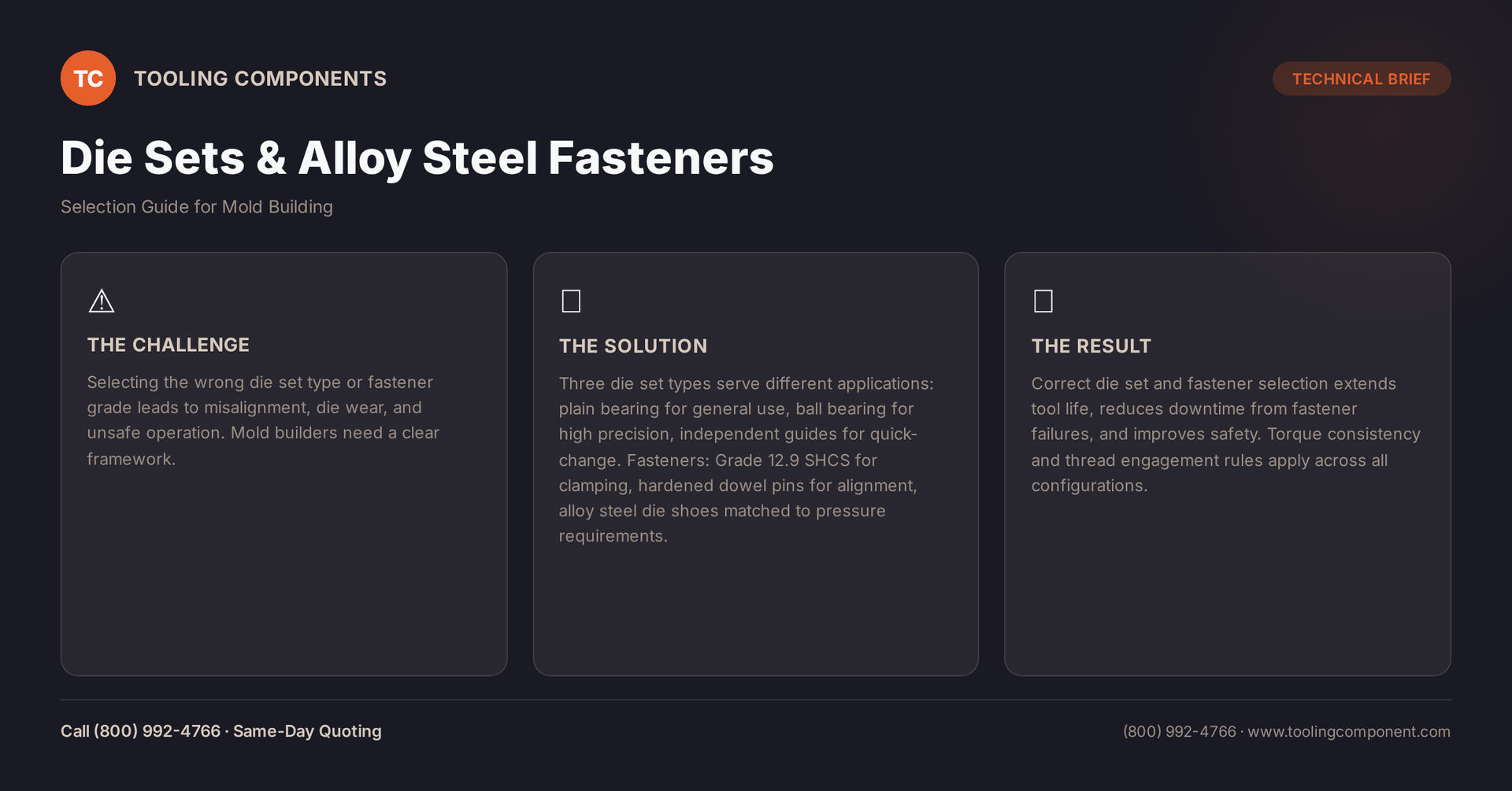
Juegos de matrices y sujetadores de acero de aleación: la base de la construcción de moldes de precisión
Cada molde de inyección o troquel de estampado comienza con un juego de troquel: el conjunto de pasadores guía, casquillos y zapatas de troquel que establecen la alineación y soportan los componentes de trabajo. Y cada juego de troqueles se basa en sujetadores de aleación de acero para mantener esos componentes en su lugar. Seleccionar la configuración o el grado de sujetador incorrectos introduce desalineación, desgaste prematuro y riesgos de seguridad.
Esta guía cubre los tipos de juegos de matrices, los grados de sujetadores de aleación de acero utilizados en la construcción de moldes y cómo combinar ambos con su aplicación.
Tipos de juegos de matrices para construcción de moldes
Los conjuntos de matrices se dividen en tres configuraciones principales, que se distinguen por la forma en que los pasadores guía interactúan con los casquillos:
| Tipo | Construcción | Mejor aplicación | Liquidación |
|---|---|---|---|
| Juego de matrices con cojinetes lisos | Pasador guía sólido que se desliza en un casquillo de acero o bronce con ranuras para grasa | Moldes de inyección de uso general, estampado a velocidad moderada matrices, herramientas prototipo | 0.0005"–0.0015" por lado |
| Juego de matrices con rodamientos de bolas | Bujes de bolas de recirculación alrededor del pasador guía: fricción mínima, sin contacto de metal con metal | Moldes de alta producción, herramientas de cavidades múltiples, matrices de precisión que requieren carrera larga y cero irritaciones | 0.0001"–0.0003" por lado |
| Juego de pasadores guía independientes | Pasadores guía accionados por resorte montados por separado de las zapatas; los pasadores se retraen dentro de la zapata cuando se abren | Matrices de cambio rápido, herramientas de transferencia, aplicaciones en las que el juego de matrices debe separarse por completo | Varía según el diseño |
Regla de selección clave: Utilice cojinetes lisos para herramientas de uso general con menos de 200 golpes por minuto. Cambie a rodamientos de bolas para aplicaciones de ciclo alto y tolerancia estricta donde el desgaste de los pasadores o del buje provoca tiempo de inactividad.
Sujetadores de acero de aleación en la construcción de moldes
Los sujetadores en un juego de troqueles no son hardware genérico: son componentes de acero de aleación tratados térmicamente y rectificados con precisión, seleccionados por su resistencia a la tracción, resistencia al corte y vida útil a la fatiga.
Tornillos de cabeza hueca (SHCS): grado 12.9
El sujetador principal para sujetar secciones de matrices, retenedores, placas extractoras e inserciones de cavidades. El grado 12.9 es el grado estándar más alto para tornillos de cabeza hexagonal:
- Material: acero de aleación 4137 o 4140, templado y revenido
- Resistencia a la tracción mínima: 180.000 psi (1.240 MPa)
- Dureza: 39–44 HRC
- Características: Recubrimiento de óxido negro o fosfato para resistencia a la corrosión; roscas de precisión (ajuste de clase 3A para una precarga consistente)
Pasadores: acero de aleación endurecido
Los pasadores proporcionan una alineación precisa y repetible entre las mitades de la zapata del troquel, los insertos de cavidad y los componentes extraíbles. A diferencia de los SHCS, los pasadores son puramente dispositivos de alineación: soportan carga de corte pero no tensión:
- Material: acero para rodamientos 52100 o 4140, templado a 58–62 HRC
- Acabado esmerilado: 0,0001"–0,0002" sobredimensionado para ajuste de interferencia en el componente fijo, ajuste deslizante en el componente acoplado
- Tolerancia estándar: clase de ajuste ISO m6 o h6
Resortes y pernos de hombro (pernos extractores)
Los pernos de hombro (también llamados pernos extractores) combinan un hombro rectificado de precisión con un extremo roscado: guían la placa extractora y permiten el desplazamiento vertical. Fabricados en acero de aleación (series 4140, 41xx), tratados térmicamente a 37–42 HRC.
Especificaciones de materiales para zapatas de troqueles
| Material | Dureza | Resistencia a la tracción | Mejor para |
|---|---|---|---|
| 4140 Preendurecido | 28–32 HRC | 140–160 ksi | Zapatos de matriz de uso general: buen equilibrio entre maquinabilidad y resistencia, la opción más común |
| 4340 | 30–36 HRC | 150–180 ksi | Matrices grandes, moldes de alta presión y cavidades: mayor tenacidad que 4140 |
| 4130 Normalizado | 20–25 HRC | 90–110 ksi | Construcciones de matrices complejas que requieren soldadura: la mejor soldabilidad de la serie 41xx |
| Acero para herramientas (A2, D2, S7) | 58–62 HRC | 250+ ksi | Juegos de troqueles maestros, aplicaciones de alto desgaste: carburados para resistencia al desgaste, costosos |
Prácticas recomendadas para la instalación de sujetadores
- Enganche de rosca: mínimo 1,5 veces el diámetro del tornillo en acero (p. ej., un SHCS de 3/8" necesita al menos 0,56" de compromiso de rosca)
- Consistencia del torque: use roscas lubricadas (aceite liviano) y una llave dinamométrica calibrada; los sujetadores 12.9 sin lubricar pueden alcanzar el 70 % del rendimiento antes de que se cumpla la especificación de torque
- Secuencia de torque: Apriete en cruz patrón en tres pasadas: 50 % → 75 % → 100 %
- Fijador de roscas: Loctite de resistencia media (azul) 242 para uso general; 271 de alta resistencia (rojo) para sujeción permanente bajo vibración
- Inspección: Verifique SHCS para cuellos o distorsión de la rosca en cada desmontaje del molde; reemplácelo si hay alguna deformación visible
Modos comunes de falla de sujetadores
| Modo de falla | Causa raíz | Prevención |
|---|---|---|
| Desmontaje del cabezal | Atornillador desalineado o de par excesivo | Calibrar la llave dinamométrica; use destornilladores hexagonales con punta esférica a toda profundidad |
| Desgarro de roscas | Instalación en seco en sujetadores 12.9 | Siempre lubrique las roscas con aceite ligero para máquinas o antiagarrotamiento |
| Fractura por fatiga en la raíz de la rosca | Embrague insuficiente o sobrecarga cíclica | Mantenga un compromiso de 1,5 × el diámetro; inspeccionar en desmontajes programados |
| Unión por corrosión | Humedad en la proximidad del circuito de enfriamiento | Utilice sujetadores chapados en óxido negro o zinc-níquel cerca de las líneas de enfriamiento |
Lista de verificación: juego de matrices y selección de sujetadores
- [ ] El tipo de juego de troquel coincide con la velocidad del ciclo y los requisitos de precisión (liso versus con rodamiento de bolas)
- [ ] Material de la zapata del troquel seleccionado para la presión de operación y los requisitos de soldadura (4140 versus 4340 versus acero para herramientas)
- [ ] Todos los sujetadores de sujeción son de grado Acero de aleación 12.9 o superior
- [ ] Los pasadores son de aleación de acero endurecido con ajuste de interferencia/deslizamiento adecuado según la función del componente
- [ ] Enganche de rosca verificado a 1,5 × diámetro mínimo
- [ ] Especificaciones de torque documentadas y llave calibrada disponible
- [ ] Lubricante de rosca aplicado a todos los sujetadores 12.9
- [ ] Intervalo de inspección establecido para la condición del sujetador en el molde desmontaje
¿Necesita precios el mismo día para componentes de troqueles o sujetadores de acero aleado? Llame a Tooling Components al 814-438-7657 o envíe un correo electrónico a sales@toolingcomponent.com: soporte de ingeniería para fabricantes de moldes y matrices desde 1987.