
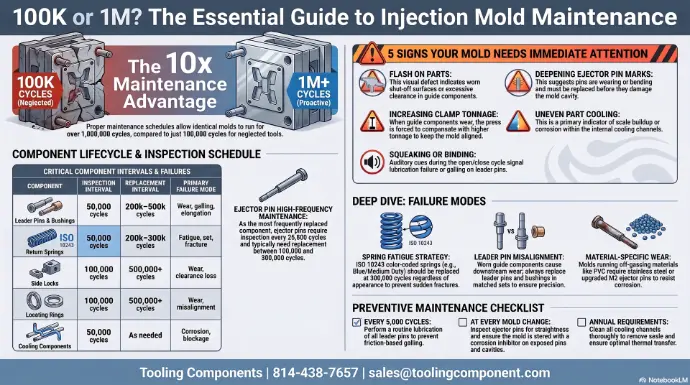
Mold Maintenance: The Difference Between 100K and 1M Cycles
An injection mold is a precision assembly. Every component — from leader pins to ejector sleeves to return springs — operates within tight tolerances. When one component wears, it accelerates wear on everything else.
At Tooling Components, we've seen molds that ran 1 million+ cycles with proper maintenance and identical molds that failed at 100,000 cycles from neglect. The difference wasn't the tool steel. It was the maintenance schedule.
Component Inspection Schedule
| Component | Inspection Interval | Replacement Interval | Failure Mode |
|---|---|---|---|
| Leader pins & bushings | Every 50,000 cycles | 200,000–500,000 cycles | Wear, galling, elongation |
| Ejector pins | Every 25,000 cycles | 100,000–300,000 cycles | Bending, wear, flash |
| Return springs | Every 50,000 cycles | 200,000–300,000 cycles | Fatigue, set, fracture |
| Side locks | Every 100,000 cycles | 500,000+ cycles | Wear, clearance loss |
| Locating rings | Every 100,000 cycles | 500,000+ cycles | Wear, misalignment |
| Cooling components | Every 50,000 cycles | As needed | Corrosion, blockage |
Five Signs Your Mold Needs Immediate Attention
- Flash on parts — indicates worn shut-off surfaces or excessive clearance in guide components
- Ejector pin marks deepening — pins are wearing or bending, requiring replacement before they damage the cavity
- Increasing clamp tonnage — guide components are wearing, forcing the press to compensate
- Uneven part cooling — check cooling channels for scale buildup or corrosion
- Squeaking or binding during open/close — lubrication failure or galling on leader pins
Common Component Failure Modes
Ejector Pins
The most frequently replaced component in any injection mold. Ejector pins fail from:
- Bending — too small a diameter for the ejection force required
- Wear — inadequate hardness for the mold material (upgrade from H13 to M2 or stainless)
- Corrosion — in molds running PVC or other off-gassing materials
Leader Pins and Bushings
Worn guide components cause misalignment, which accelerates wear on every downstream component. Replace in matched sets. Signs of wear: visible scoring, measurable clearance increase, or inconsistent part dimensions.
Mold Springs
ISO 10243 color-coded springs have defined fatigue lives. A blue spring (medium duty) is rated for 300,000 cycles at 25% deflection — after that, it should be replaced regardless of visible condition. Springs fail without warning; a fractured spring can damage the mold face.
Preventive Maintenance Checklist
- Lubricate leader pins every 5,000 cycles
- Inspect ejector pins for straightness at every mold change
- Replace springs per ISO 10243 fatigue schedule — don't wait for failure
- Clean cooling channels annually or per resin manufacturer recommendation
- Store molds with corrosion inhibitor on exposed pins and cavities
Need replacement components for your mold maintenance?
We stock all ISO/standard sizes and can cross-reference any brand.
Call 814-438-7657 or email [email protected]
Same-day quotes. Hot-shot delivery available within 100 miles of Union City, PA.