Caso real: Marlan Tools: construcción de moldes en lugar de comprar bases terminadas
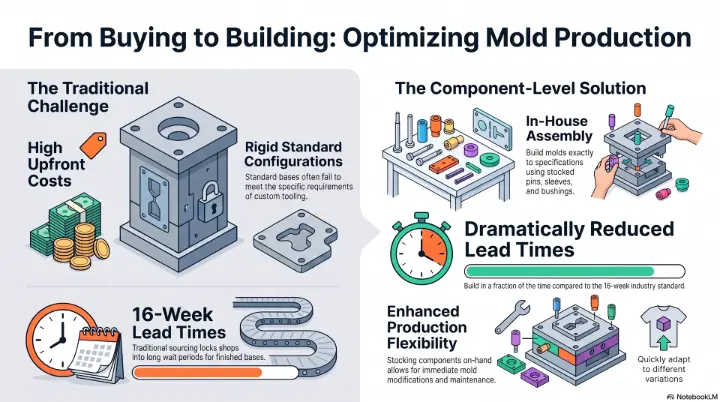
Un taller de moldes y matrices estaba gastando demasiado en el costo total de propiedad de las bases de moldes terminadas. El enfoque tradicional (comprar bases de moldes preensambladas de grandes proveedores) implicaba altos costos iniciales y los encerraba en configuraciones estándar que no siempre coincidían con sus requisitos de herramientas específicos.
Solución de componentes de herramientas
Tooling Components les permitió comprar componentes individuales (pasadores, manguitos, casquillos, rieles guía y otros elementos de construcción de moldes) para construir sus propias bases de moldes internamente. Al adquirir los componentes por separado a través del catálogo de Tooling Components, el taller obtuvo la flexibilidad de construir moldes exactamente según sus especificaciones y, al mismo tiempo, reducir significativamente los costos de material.
Marlan Tool se especializa en la fabricación de piezas de tolerancia estrecha y en el diseño de soluciones de herramientas personalizadas. Sus capacidades incluyen herramientas y diseño personalizados (moldes de inyección de plástico, desde prototipos simples hasta moldes complejos de acción múltiple y desatornillado, troqueles progresivos, accesorios, calibres y herramientas de repuesto); mecanizado avanzado que utiliza centros de mecanizado vertical 3D de alta velocidad con capacidades de fresado en duro, fresadoras de grafito 3D de alta velocidad, tornos CNC y centros de mecanizado vertical CNC estándar; Servicios de electroerosión que incluyen electroerosión por hilo y electroerosión por RAM CNC; y rectificado y mantenimiento de moldes, incluido rectificado de superficies de tolerancia estrecha con rectificado de carburo especializado, modificaciones de moldes, reacondicionamiento y mantenimiento de rutina de moldes.
El resultado
Al cambiar a la compra a nivel de componentes a través de Tooling Components, el taller redujo drásticamente su tiempo de entrega de 16 semanas para bases de moldes terminadas a una fracción de ese tiempo al construirlas internamente. Los ahorros de costos iniciales fueron significativos y ahora tienen en stock los componentes para construir sus propios moldes según sea necesario, lo que elimina los largos plazos de entrega y los precios elevados de las bases de moldes terminadas.
Conclusión clave: para los talleres de moldes y matrices con capacidades de mecanizado internas, la compra a nivel de componentes puede transformar tanto la estructura de costos como la flexibilidad de producción.
Conclusiones clave para los fabricantes de moldes
Cuando se enfrente a trabajos con nervaduras profundas o cavidades de paredes delgadas: seleccione herramientas con la longitud de ranura efectiva más larga necesaria, no más; utilizar geometría de hélice variable para romper patrones de vibración armónica; considere trayectorias trocoidales para acabados de cavidades profundas; invertir en recubrimientos TiAlN o AlTiN para aceros para herramientas endurecidos; y verifique la desviación del portaherramientas: incluso 0,0002 pulgadas de desviación pueden duplicar la variación del acabado de la superficie en un alcance extendido.
Tooling Components cuenta con una amplia gama de fresas de carburo, herramientas especiales y componentes de moldes para mecanizado de cavidades complejas. Comuníquese con nuestro equipo técnico de ventas para obtener recomendaciones específicas para cada aplicación.