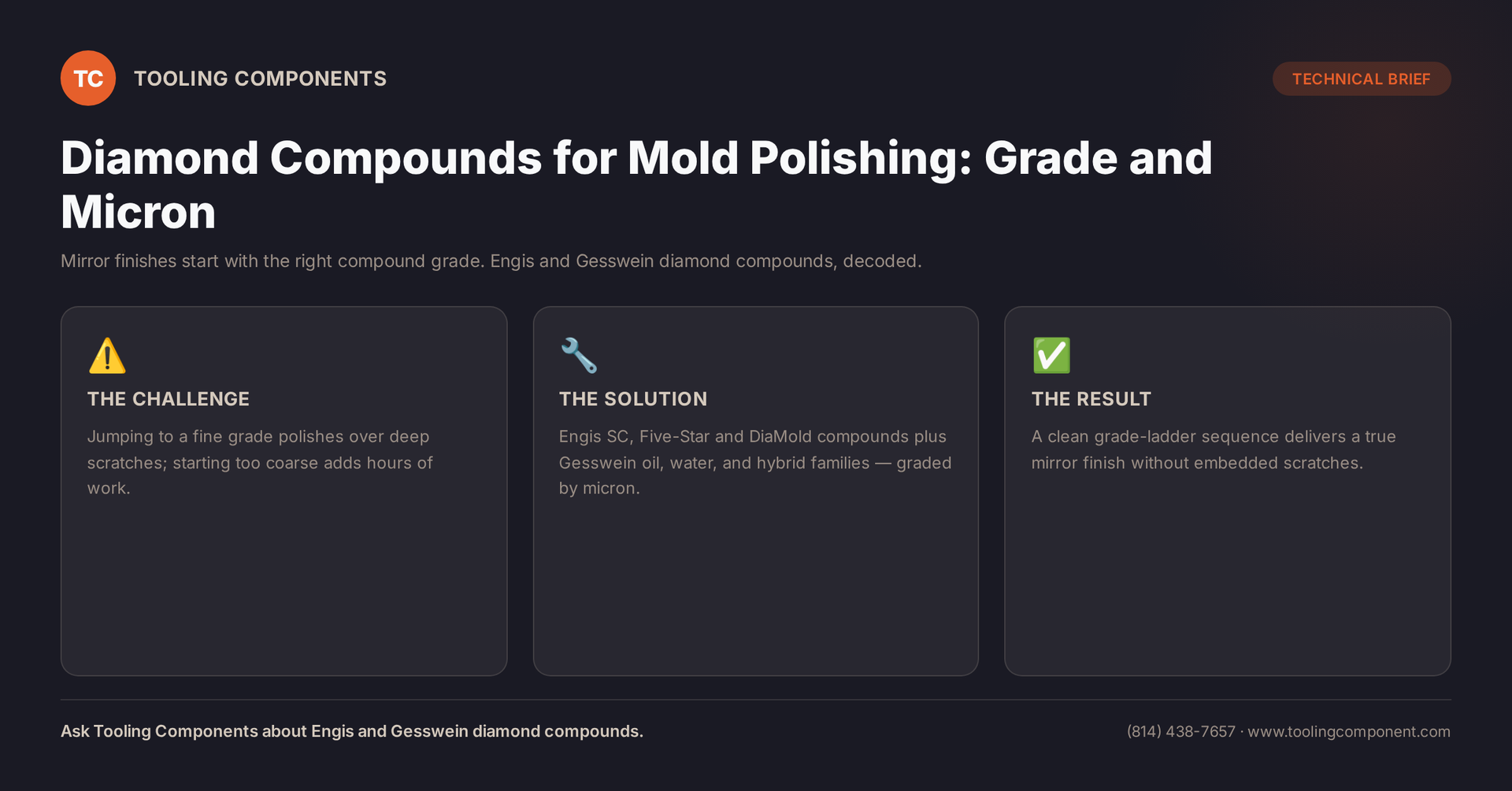
A mirror finish on a mold cavity is not one operation — it is a sequence of increasingly fine grades, each removing the scratches left by the last. Jump straight to a fine grade and you polish over deep scratches; start too coarse and you add hours of unnecessary work. Tooling Components stocks diamond compounds from two industry leaders — Engis and Gesswein — both organized as a micron-grade ladder, and reading that ladder correctly saves both time and surface quality.
Engis: SC and Five-Star Diamond Compounds
Engis SC (Super-Cut) compound was formulated with the polishing professional in mind. It uses a new carrier with superior lubrication qualities and better adhesion to the wool-felt bob or wood bob, so you can see the workpiece while you polish and finish without constant reapplication.
Five-Star® diamond compound is Engis's flagship line. It is both oil- and water-soluble and combines the cutting characteristics of natural diamond with the durability of manufactured diamond for superior finishing capability. For budget-minded shops, Engis also offers DiaMold® for standard applications, plus specialty formulations, water- and oil-soluble polishing lubricants, and a non-diamond High Intensity Polish to bring out the final finish.
Gesswein: Oil, Water, and Hybrid Compound Families
Gesswein diamond compounds are trusted by mold and die professionals for fast, consistent cutting. They come in three carrier families so you can match the compound to your process: water-soluble, oil-soluble, and hybrid formulas. Gesswein also carries Hyprez® DiaMold high-temperature compounds, Supra compounds in a range of micron grades, and pre-built diamond polishing and compound sets to cover an entire finishing sequence in one kit.
Reading the Grade Ladder
Both brands grade their compounds by micron size — the smaller the micron rating, the finer the cut. The progression is always the same:
- Coarse grades (larger micron) — stock removal and heavy scratch elimination on hardened tool steel.
- Mid grades — pre-polish lapping, bridging stock removal to fine polishing.
- Fine grades (smaller micron) — final polish and the mirror finish.
Building the Sequence
A typical hardened mold cavity starts with abrasive stones, then moves to diamond compound: a coarser grade for stock removal, mid grades to refine, and the finest grade for the final mirror. Step down by roughly half the micron rating each pass — skipping a step embeds scratches that reappear after the first production run.
Oil vs. Water vs. Hybrid
- Water-soluble — easy cleanup, well suited to most mold steels.
- Oil-soluble — longer-lasting carrier, suited to heavier stock removal and harder materials.
- Hybrid — combines the cutting speed of an oil base with easier cleanup.
Tooling Components stocks Engis and Gesswein diamond compounds across the micron-grade ladder and can help you build a sequence matched to your material and finish requirement.
Contact Tooling Components at 814-438-7657 for diamond compound grade selection and stock.