
Pasadores y bujes Leader: guía de selección para la alineación de moldes y matrices
Los pasadores y bujes Leader son los héroes anónimos de la alineación de moldes y matrices. Sin ellos, las mitades del molde se desplazan, los núcleos se desalinean y las piezas salen fuera de tolerancia. Esta guía cubre los tipos, materiales y criterios de selección para elegir los componentes de alineación correctos.
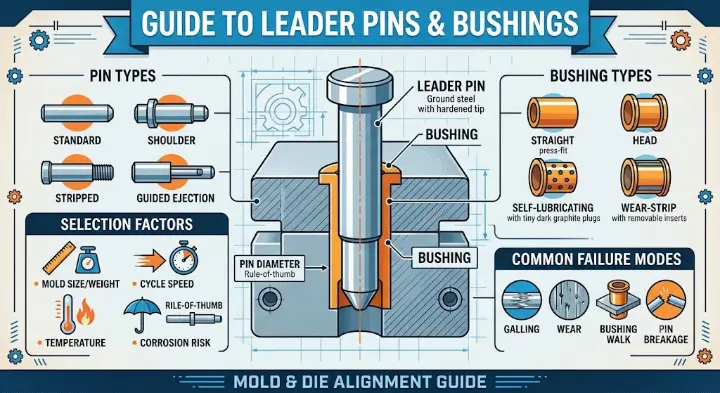
Pasador guía Tipos
Pasadores guía estándar: Pasadores de acero rectificado y pulido con superficie endurecida. Se utilizan en la mayoría de los moldes de inyección y matrices de estampado para alineación de uso general.
Pasadores guía del hombro: Presentan un hombro más grande que actúa como un tope positivo. Se utiliza cuando la profundidad precisa de la proyección del pin es fundamental.
Pasadores guía pelados: Incluye una porción roscada para unir a la placa separadora en troqueles de estampado.
Pasadores guía de expulsión guiada: combinan la alineación con la funcionalidad de expulsión. Común en moldes grandes con secuencias de expulsión complejas.
Tipos de bujes
Bujes rectos: El tipo más común. Ajuste a presión en la placa del molde. Se utiliza con pasadores guía estándar.
Bujes del cabezal: cuentan con una brida que evita que el casquillo sea empujado a través de la placa. Más fácil de reemplazar que los casquillos rectos.
Bujes autolubricantes: Contienen tapones de grafito o material de bronce que reduce la necesidad de lubricación externa. Ideal para aplicaciones de ciclo alto.
Bujes de tira de desgaste: Incluye tiras de desgaste reemplazables que extienden la vida útil sin reemplazar todo el buje.
Selección de materiales
| Material | Dureza | Mejor para |
|---|---|---|
| Acero para herramientas (O1, A2) | 58-62 HRC | Aplicaciones de uso general y alto desgaste |
| Acero endurecido | Caso 60-64 HRC | Moldes de ciclo alto, ambientes abrasivos |
| Acero inoxidable (420) | 48-52 HRC | Ambientes médicos, de calidad alimentaria y corrosivos |
| Bronce/Latón | — | Aplicaciones autolubricantes de baja velocidad |
Factores clave de selección
- Tamaño y peso del molde: Los moldes más grandes requieren pasadores de mayor diámetro. Regla general: diámetro del pasador = 0,02 x ancho del molde.
- Velocidad del ciclo: El moldeado de alta velocidad genera más desgaste. Actualice a acero autolubricante o endurecido.
- Temperatura de funcionamiento: Los moldes de alta temperatura provocan expansión térmica. Tenga en cuenta los cambios de holgura a la temperatura de funcionamiento.
- Riesgo de corrosión: Las aplicaciones médicas, alimentarias o exteriores necesitan acero inoxidable.
- Acceso para mantenimiento: Los pasadores de difícil acceso se benefician de los casquillos autolubricantes.
Modos de falla comunes
- Desgarro: Transferencia de metal entre el pasador y el buje. Causado por una lubricación inadecuada o materiales que no coinciden.
- Desgaste: Pérdida gradual de material por ciclo. Acelerado por contaminación o alta velocidad.
- Paseo del buje: El buje empuja a través de la placa. Arregle cambiando a casquillos de cabeza.
- Rotura de pasador: generalmente por desalineación o masa de molde sobredimensionada.
¿Necesita ayuda para seleccionar los pasadores y casquillos guía adecuados? Tooling Components cuenta con una gama completa de componentes de alineación en tamaños estándar y personalizados. Contáctenos para obtener una cotización el mismo día.